Community of Practice
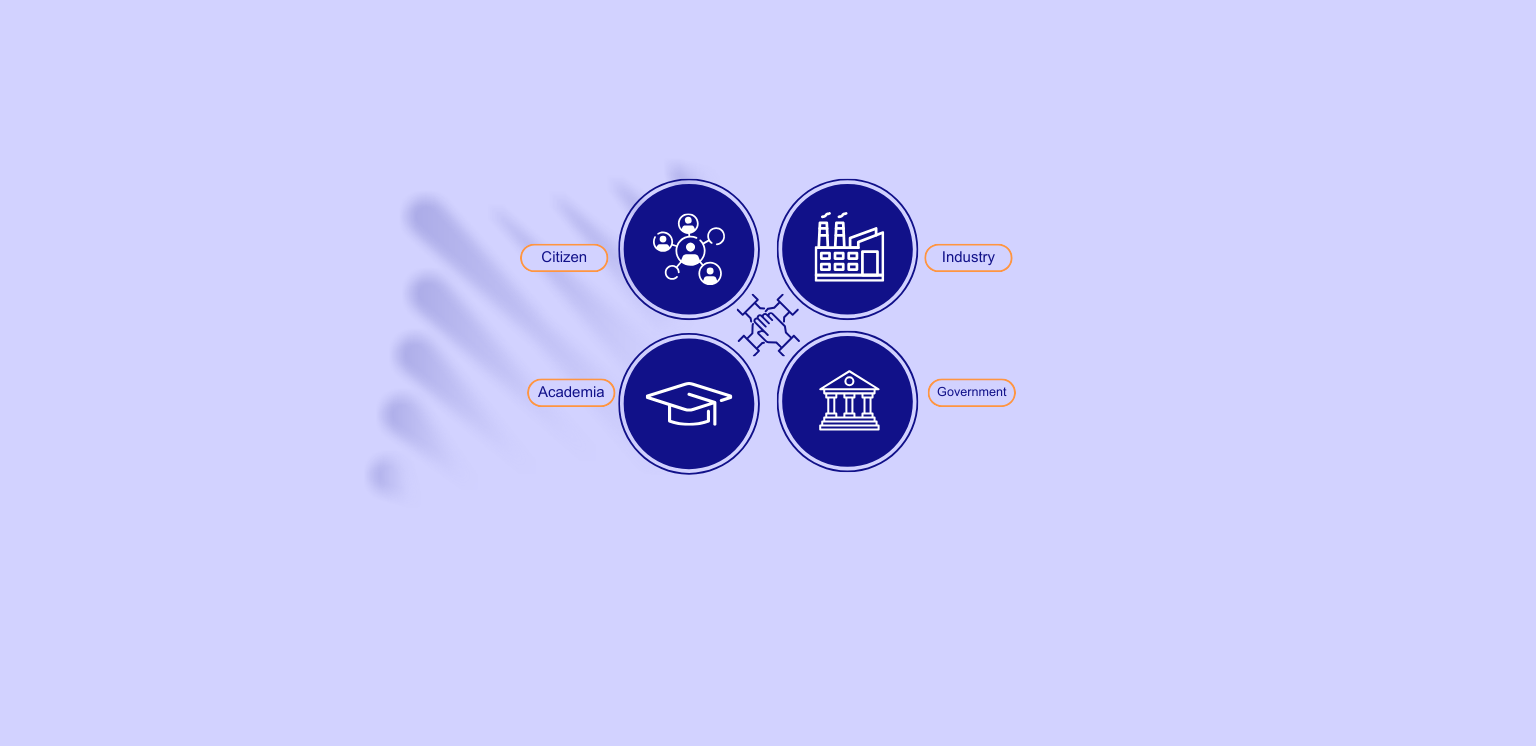
A Community of Practice is a group of people who share a common challenge and meet regularly to learn from each other and solve practical problems together
Connecting people to solve Baltic Sea challenges
The Baltic Sea region has the knowledge, technology and ambition to grow its blue economy. What it often lacks is a practical way to bring the right people together at the right time.
Researchers generate knowledge. Companies test new solutions. Policymakers design regulations. Coastal communities experience the real-life impact of decisions. Yet they rarely sit at the same table when it matters most. As a result, promising ideas struggle to move from concept to pilot and from pilot to market. Companies search for partners and permits on their own, while decision-makers lack coordinated input to support scaling.
This is where the MarTe Community of Practice comes in.
Bringing the right people together early enough
The idea is straightforward: bring the key actors of the Baltic Sea blue economy together early enough to solve problems before they become barriers.
The MarTe Community of Practice (CoP) is a cooperation network between Estonia and Latvia. It connects marine and maritime companies, technology developers and startups, universities and research institutions, policymakers and public authorities, regional development and investment actors, as well as coastal and environmental organisations. In short, it brings together those who plan, test, regulate, finance and use marine innovation.
In practice, cooperation happens through thematic events, workshops, trainings and webinars. Participants also stay connected through the MarTe newsletter and ongoing communication between meetings. Over time, this creates something more valuable than a single event — a network of people who know each other, understand each other’s roles and can pick up the phone when cooperation is needed.
Two Communities of Practice are being developed within MarTe — one in Estonia and one in Latvia — working in parallel and learning from each other. The focus is practical: real challenges emerging from the marine sector, not abstract strategy discussions.
Recent discussions have highlighted, for example, the need for clearer marine testbed environments — real-life settings where new marine technologies can be tested — alongside more transparent permitting processes, stronger investment readiness and better data-driven marine planning.
When real problems are put on the table
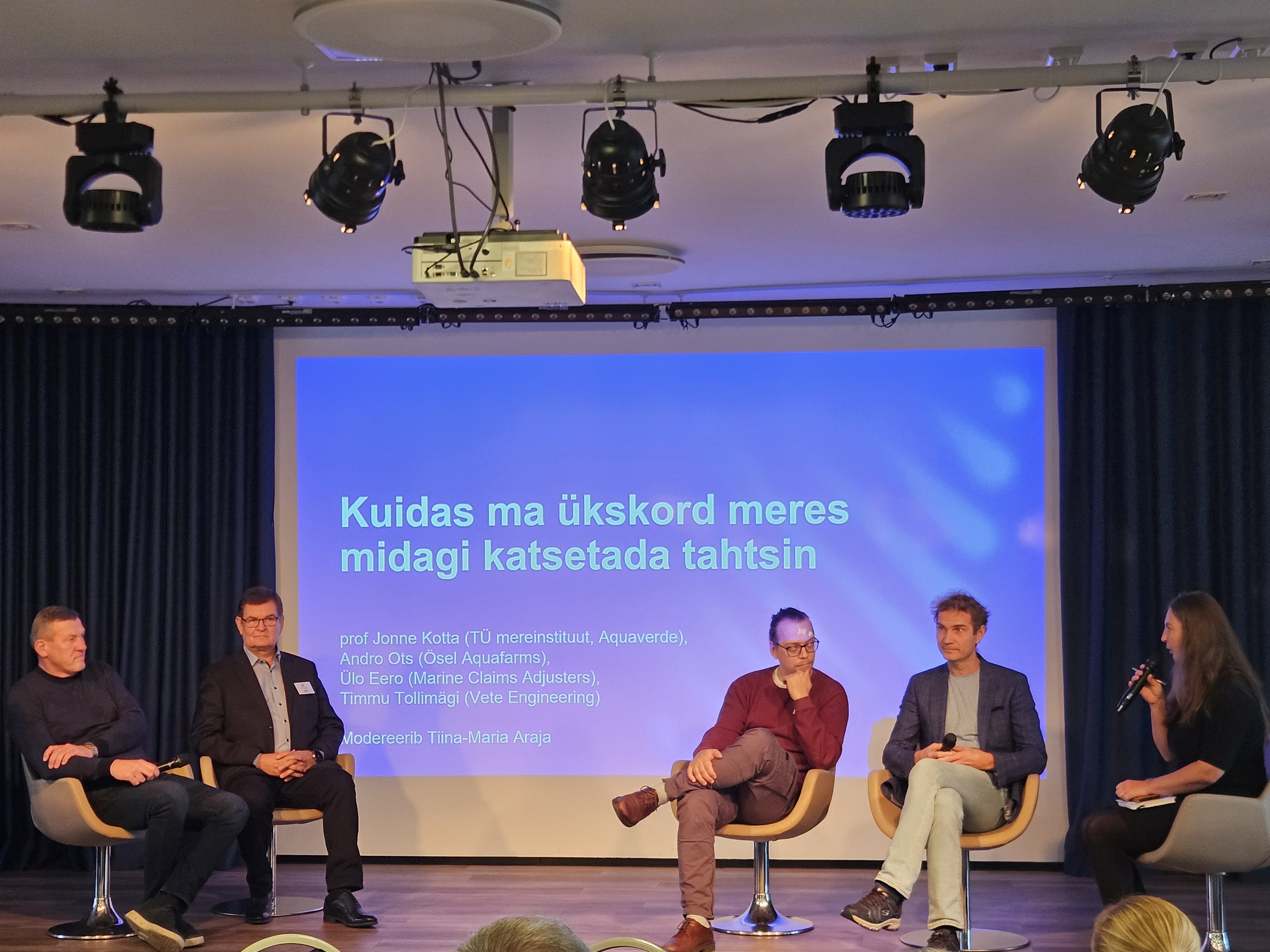
MarTe Vision Seminar, Pärnu, October 2025.
The impact of the Community of Practice becomes visible when concrete challenges are openly discussed.
At the MarTe Vision Seminar in Pärnu (October 2025), entrepreneurs and researchers shared first-hand experiences of testing innovations at sea.
Two practical proposals emerged from the discussion:
- A public database of ports and coastal areas open for testing
- A clear guideline explaining how to obtain permits for marine testing
These are not abstract ideas. They are examples of how dialogue can turn into concrete steps that make innovation easier and faster.
For companies, the Community of Practice reduces uncertainty by clarifying processes and connecting them with research partners and public authorities. For researchers, it improves the relevance of their work by linking it directly to industry needs. For policymakers, it offers grounded feedback before regulations are finalised.
From fragmented efforts to long-term cooperation
The Community of Practice is not “just another networking initiative.” Its value lies in continuity. When stakeholders meet repeatedly and work around shared challenges, cooperation becomes more efficient and trust-based. Trust, in turn, makes long-term partnerships more likely.
If this approach works, marine testing will become easier, innovations will reach the market faster and cross-border cooperation between Estonia and Latvia will feel less like an exception and more like the norm. Research, business and policy will work more closely together, and companies will be better prepared to attract investment and scale their solutions.
Without continued cooperation, many promising ideas would still struggle to move beyond the pilot stage.
Stay connected
The Community of Practice is open to organisations and professionals active or interested in the blue economy in Estonia and Latvia.
Join the MarTe newsletter to stay informed about upcoming seminars, workshops, webinars and project developments.



Funded by the European Union under Grant Agreement ID 101186498. Views and opinions expressed are however those of the author(s) only and do not necessarily reflect those of the European Union. Neither the European Union nor the granting authority can be held responsible for them.